Showing posts with label insects. Show all posts

Thursday, May 2, 2013

Walk the Cat

The world is mine oyster.
Walking cats on a leash is rather boring.

I don’t even know why I’m writing about it.

The hardest part is convincing the cat to wear a harness. It offends their deepest sensibilities. Olive feigns a struggle on principle, knowing secretly that the harness is her ticket to the mysteries of the unknown.

It’s adorable for the first five minutes or so, watching the cat behold the breathtaking world of grass, trees, and swarms of insects. Within seconds, there is a cloud of flies in orbit around my head like space debris. I want to go home.

When I walk Olive, the first thing she wants to do is ditch me. She tries to duck under a spiky bush or crawl into the spaces under the stairs. No amount of arguing will dissuade her from exploring tight crevices, so I pick her up and move her somewhere more human-friendly, hoping to disorient her enough that she forgets just how fascinating the spiky bush is.


Then Olive sees a majestic cardinal and she ducks down to watch it for the next ten minutes, chirping with predatory flicks of the tail. I wonder if the chirping is Olive’s interpretation of a mating call, in hopes of luring a desperate and confused bird into her open jaws. The bird is twitching its crest, fanning its tail feather – a come-hither in the universal language of love.
                                                                                              
Soon she finds something a hundred times more interesting than either bird or bush. It is a bit of sidewalk covered in a metropolis of ant hills for Olive to roll in. These are ants either of the red, bity persuasion or the refugee ants that gorged on our tahini last year, eventually conquered by Dave and some borax. Somehow they all live in quiet harmony in the cracks of the walkway. Olive collapses onto her back as though coerced by something stronger than her will. I lift her away from the anthills before the ants recognize Olive as a point of entry into our home.

Once Olive is begrudgingly within the apartment, freed from the leash that binds her, she is already craving more. What secrets lay entangled within the spiky bush? Will rolling in the ant hill fill the emptiness inside her? Now Olive will never know. Penny is nearby and before she knows what is happening I have the harness slipped over her head and fastened around her legs, secure as a straitjacket  I am very proud of this accomplishment. After six months with Penny, I have never managed to hoodwink her into a harness. Now she’s nice and snug and I lift her through the door.

For ten minutes, Penny stands just outside of the doorway. She is testing the waters. I don’t think Penny remembers grass and dirt. Then the spiky bush calls to her like a relentless siren. Come all ye cats, says the spiky bush. Alas, I cannot hear the bewitching music myself.

Penny weaves her way up the stairs to my landlord’s part of the house and gets tangled in the railing. With a tremendous tug, she shoots through the harness and leaves it dangling on the rails. Fortunately for me, she is too bewildered by nature to get far. I scoop her up and bring her indoors.

Once cats get a taste of taking walks outside, they can never go back. Olive is at the door now, trying to turn the doorknob with both paws, falling short of the strength and the appendages needed to actually do it.

Now that Penny has experienced the harness, I’m one step closer to training my cats to pull a chariot – the only reason I take them for walks at all.


Saturday, May 19, 2012

Indigestion


My neighbor is a twelve-year-old girl with a Venus flytrap. I have other neighbors, but they are not important.

This afternoon I called her to the bushes that divide our residences. She was riding her bike back and forth in the driveway, the pompoms on the handlebars rustling in the breeze. I inquired about her Venus flytrap, Tito, and she fetched the darling little hydra from her porch. Tito is a boy, she explained, because no girl would ever eat flies.

She won her carnivorous plant with a golden ticket at a school raffle. Her plant is far more intimidating than mine ever got before it was scorched to the root in a tiny, contained brush fire. As far as my neighbor is concerned, her plant is as good as a pet.

She found some black and yellow caterpillars on the porch and dropped one into each hungry mouth, which snapped shut like a bear trap. Two days have passed since the barbarian feast and the siesta continues. You can still make out the outlines of the little yellow caterpillars gurgling in acidic juices. The mouths are all still shut. Venus flytraps, the politest of predators, never chew with their mouths open.

Tomorrow morning, the carnivorous plant next door may very well explode into butterflies. Who will prevail, the predatory plant or the very hungry caterpillar?

Friday, December 30, 2011

Fit for a Fungus

Before I moved into the new apartment, I bought a rosemary bush that was shaped like a Christmas tree. I had every intention of stringing it up with lights and beads like a Christmas tree. Then December came around and I had a brown, spiky bush-skeleton shedding its needles on my windowsill. It wasn't as festive as I had hoped.

What went wrong?

My apartment is in a dusty basement. The last renters were eyeless mole-people. Prehistoric insects creep out of the cracks in the molding and the spaces where the pipes go through the ceiling, the wiggling ancestors of the centipede and mutant spiders that I catch in old ricotta cheese tubs and shake onto the driveway.

The windows are small, but at least there are windows. My landlords left wooden planks stacked in front of the kitchen windows to make me feel like I live in an 1850’s tenement, so very little natural light shines in. I have become a mole-person.


Yet I am not bereft of hope. Angelina, my pitcher plant, is thriving in the window beside this very desk, in full view of a creepy boarded-up garage. The little hairs that are springing up on her lips - her mustache, if you will - remind me of the tiny flesh-scraping hooks on a cat's tongue.


The day I moved in, I announced that I wanted to immediately procure a plant. Having a plant gives me the illusion that I am a responsible adult. “What could you possibly grow in here?” my mom asked.
“Mushrooms,” I declared.

I may have suggested mushrooms in jest, but now I’m completely serious. I stumbled upon this mushroom kit from Back to the Roots. This mushroom garden, which resembles a happy meal for gnomes, purportedly produces a sprawling mass of oyster mushrooms in ten days and produces at least two crops. The spore-filled soil inside of the happy meal box is made of recycled coffee grounds.

The process seems fool-proof, even for one prone to causing small forest fires in terrariums. You spray the coffee ground soil with the spritzer and mushrooms will grow. I may have found the ideal plant (or in this case, fungus) to grow in the dark.

Monday, July 25, 2011

Along Came a Spider


One night I went outside to gather some oregano for an improvisational bean dip. I approached my patch of herbs with a pair of scissors in hand and jumped as I beheld the most enormous spider web I have ever seen. It stretched from my house to a nearby cedar tree.

The most massive spider I have ever seen (that wasn’t tarantula in a small plastic carrying case with holes on the top) was constructing the outer rings. I suspect that it is one of those spiders from Australia that survive underground for years without water and eat honey badgers. Boy Scout points to anyone who can confirm this baseless speculation.


I ran into the house to fetch my camera-savvy brother. Perhaps I would have found this late night session of nature photography and flashing lights dangerous and invasive were it not for the “PHOTOGRAPH ME” message scrawled in iridescent web. I stood nearby holding an LED flashlight so that my brother could get a good view of the spider.


As we looked on, a fly was caught in the tremendous web and the spider swiftly dove upon it and wound it up like an unwilling bobbin. She left it alone, squirming in an iridescent straightjacket, and went on with her weaving. “This is nature!” I cried.

I carefully picked a few sprigs of oregano that were not bolstering the web to prevent my hand from being mummified in a similar fashion. Nature can be cruel, my friends.

Sunday, July 10, 2011

Not So Carnivorous After All


            I was making a quinoa salad in my kitchen when I noticed an enormous black ant skittering across the floor tiles. I considered taking it outside where it could start a nice little homestead in the hostas, but then it occurred to me: I have a carnivorous plant. Instead of releasing the ant into its natural habitat, I moved it into hostile, flesh-eating territory.

I dropped its wriggling body from a mason jar into the open terrarium in the bay window. After I closed the lid, the ant crawled up and down the dewy walls of the terrarium and danced spastic circles around the red lips of the pitcher plant’s largest mouth. I watched in horror, waiting for the moment where he slipped down the waterslide into the digestive acids of doom. But no, he moved from the plant’s mouth to the wall of the terrarium once more and slipped into the peat moss.

The ant waved his fragile legs in the air so pitifully that I promptly opened the terrarium and rescued him from its swampy depths. I transferred him to the porch, where he will probably take advantage of the next opportunity to reenter my house.


I considered the pitcher plant, which has sprouted another luscious, red mouth since my last portrait session. Everything I’ve read on the subject of pitcher plants indicates that they aren't amazing photosynthesizers and require meaty meals, but my recent experiences have planted a seed of doubt in the peat moss of my mind. She is now bonding with my cat, Holly, a creature far too large for her to comfortably digest.


I suspect that my pitcher plant, Angelina, may be a vegetarian. It is not my place to criticize; I also dislike eating things with wild, wiggly legs. Perhaps it would be more amenable to my quinoa salad, served on the tip of a pair of pincers. Keep an eye out for my new food blog, Vegetarian Recipes for Your Carnivorous Plant.

Thursday, August 19, 2010

Wood

I have about two and a half weeks before I leave for Prague, so I’m trying to focus on the important things that absolutely need to be done before I leave, such as refurbishing antique furniture. The furniture in question—two dressers, a headboard, and a matching mirror—is not necessarily antique. My mother acquired these pieces at a garage sale over the weekend for an unusually low price. They are going to replace the rickety wicker set that my cats have been using for a scratching post for the past fifteen years.


The pieces seem to be oak, and they are probably not actually antique. I noticed nearly the same set in Home Décor Magazine under the title “Inspired by Paris Flea Market Finds” and surrounded by several dozen Eiffel Towers of assorted sizes.

On Monday, my sister and I tackled the smaller set of drawers and we began to realize why the pieces were so inexpensive. We attacked the splotches of sticky goop in the top drawer with lemon juice on an old sponge. I was going to use an actual lemon, but my mom berated me for cleaning with an expensive citrus fruit. I used a bottle of Nature’s Nectar 100% Lemon Juice from Concentrate, which Mom insisted was the same thing anyways.

Since the lemon juice is far less precious than the lemons themselves, I made sure to use as much of the juice as possible and cleaned the entire dresser with it, as well as the mirror and headboard. If there was anything sticky, I avoided it early on.

After the lemon bath, there seemed to be several infinitely impossible problems to tackle. Cleaning the top of the dresser, I noticed the name “BOB” carved into the wood. I was annoyed that it could not have been a more imaginative name. A name more appropriate for furniture that seems to be inspired by Art Nouveau would have sufficed. I think “ALGERNON,” for instance, is a charming name. There’s something in that name that seems to inspire absolute confidence.

A few inches away I discovered “STEVE.” I could find only one place where the varnish was somewhat intact. It looks as if there was a table runner at some point protecting the wood from such crude adolescents as BOB and STEVE. The condition of the long dresser causes me to suspect that it was left outdoors for a while, but that the table runner was left in place.

I can think of no methods for removing the names that don’t involve destroying the wood or burning the dresser to the ground. The chips in the wood and the rusted pulls I can take, but the names make me feel as though I’m locked in a room with a bunch of insider jokes that I’m not allowed in on.


My sister and I took out the drawers. When she set one of the lemon-soaked sponges onto the unfinished wood inside of the drawer-crevice, it instantly turned black in the dust, which was at least an inch high. We broke out Venus, my pink vacuum cleaner for my dorm room. My sister vacuumed the drawers while I lemoned up the mirror. Every once and I while she would start screaming “Spiders! Spiders!” or “There’s cobwebs in the drawer! They’re black! Why are they black?!?” Then I would take over until the spiderly remains were careening down Venus’ rubber tube.

We were about to start vacuuming the inside of the dresser when my sister pointed out some paper in the top drawer-crevice. “Is it a forgotten private manuscript?!?” I cried, diving into the drawer-crevice for the stack of loose-leaf. I have been reading Either/Or by Soren Kierkegaard, which unfairly raised my hopes. Unfortunately, the yellowing lined pages did not contain a philosophical correspondence between BOB and STEVE. I was disappointed to find them all blank.

My sister had to vacuum the inside of the dresser because the sound of the brush attachment on unfinished wood, for me, is like nails on a chalkboard or a screaming kitten. I did need to assist with the removal of a spider, the species of which may have become extinct since the last time the drawer was removed about a hundred years ago.

I polished all of the rusted pulls with a paste of vinegar, salt, and flour. When I got the paste on the wood, I promptly wiped it with a wet sponge. After a few hours of this tedious work, I realized that the wet sponge was just spreading it around. I wiped it thoroughly with a second wet sponge. This time, it looked as though I destroyed the varnish. The catastrophe was much like the time Spongebob and Patrick got white paint on Mr. Krabs’s first dollar.

I had about a day’s worth of anxiety that I ruined new old furniture. Last night at about ten I was unable to bear the suspense and I wiped the dresser with a polish that was essentially homemade salad dressing. This seems to have done the trick. The only thing left to do now is get the smell out of the drawers. Baking soda and vinegar don’t seem to be doing the trick. I’m worried that the smell is mothballs, in which case all the plastic in the world will decompose before the smell dissipates.

Today I intend to tackle the taller dresser in a similar manner. I’m on the lookout for new species of spiders and a carving of “BOB+STEVE 4EVER.”

Wednesday, July 28, 2010

Unnatural Happenings in My Backyard


I believe this is the quickest I’ve ever followed one post with another. I’m sitting cross-legged at my writing desk in a thunderstorm. My hand is cramping and I would really like a snack, but I feel compelled to relate the following story.

Yesterday I saw a creature pollinating our petunias that initially appeared to be a hummingbird, but on closer inspection resembled a bumblebee. It had transparent wings with a brown border and a long curly “nose” like a butterfly. Rather than black and white stripes it was yellow with one large, brown stripe. I suspected it to be the lovechild of a hummingbird and a bumblebee, the result of a tryst forbidden by Mother Nature.

Later, chasing a plastic back across the lawn, I stumbled upon a second alien creature in the shade of the woods. I saw a patch of completely white flowers. They looked like wilted rosebuds sucked dry by a vegetarian vampire, a cross between a crocus and a fungus.

After I recovered from the shock of all of the disparate organisms breeding in my yard, I wrote an e-mail to my friend, an authority on matters of plant and animal identification, asking what they were and if I should fear them.

Before she could respond, my curiosity lead me to Google. First, I searched, “Strange hummingbird and bumblebee like insect.” I found this page. The seemingly anomalous insect turned out to be a Snowberry Clearwing Hummingbird Moth. Then I searched “Strange white and transparent flower,” and I got this page. The plant is called Indian pipe. It has no chlorophyll and feeds off of the delicious fungus on the dead leaves. It is also known as Ice-Plant, Ghost-Plant, Corpse-Plant, Plant-of-Death, Ominous-White-Plant, and many other suitable titles.

Later, my friend responded to my e-mail and confirmed my search results. My conclusion is that Google is the boy scout of the twenty-first century.

Monday, May 24, 2010

Adventures in Carnivorous Planting


Over the past few months something in me has been craving the companionship of a carnivorous plant. Following this powerful and probably fleeting whim I purchased a Bug Biting® Plant Terrarium Set. The set included one dormant Venus Flytrap, one dormant pitcher plant, a bag of soil, a bag of moss, a smaller bag of soil, and a terrarium.


A Venus Flytrap is a leafy green mouth with sharp pointy teeth that lures insects in with a sweet fragrance and promises of sexual favors. Sometimes they sing songs that are so irresistible to a fly’s discerning tympanic membrane that the fly willingly submits to its own consumption. When the delicious insect rustles the sensitive hairs inside the mouth, the jaws snap shut like a bear trap. The fly is chewed, swallowed, and digested to produce second and third heads for this hydra-like creature.

The pitcher plant is a photosynthesizing pelican of death. It looks innocent on the outside. A passing insect cannot help but imagine it going to church and sitting in a pew full of calla lilies and daffodils (except for cobra lilies, which look something like the Loch Ness monster rearing her head from your garden.) Insects are attracted to its succulent puckering lips. Once a fly enters the mouth, the trapdoor closes and the fly whizzes down a waterslide into a pool of quicksand from which they can never escape.

The terrarium provides the plants with enough humidity to replicate the swampy conditions they have come to love, while simultaneously preventing the consumption of nearby houseplants.

Now that I had learned a bit about the plants, I felt ready to fill my terrarium with carnivorous flora. Step one of the planting process brought with it many confusion questions like Where are the plants? and Which side of the terrarium do I plant into? The directions indicated that the carnivorous plants were hibernating in the smaller bag of soil. In the smaller bag I found two clumps of dirt. Upon closer inspection, one clump of dirt had leaves and the other had roots. I could not tell which one was the pitcher and which one was the flytrap, but if I patiently wait long enough I suppose one will grow teeth. The plants looked nothing like the diagrams, nor did they resemble the familiar images provided by Crash Bandicoot.

I woke up my mother with a dormant carnivorous plant in either hand asking her which side was up. Thanks to the deterioration of her visual capacities, I was forced to make an educated guess. After filling what I thought was the base of the terrarium with a layer of soil and a layer of moss, I inserted the dormant beasts into the moss.

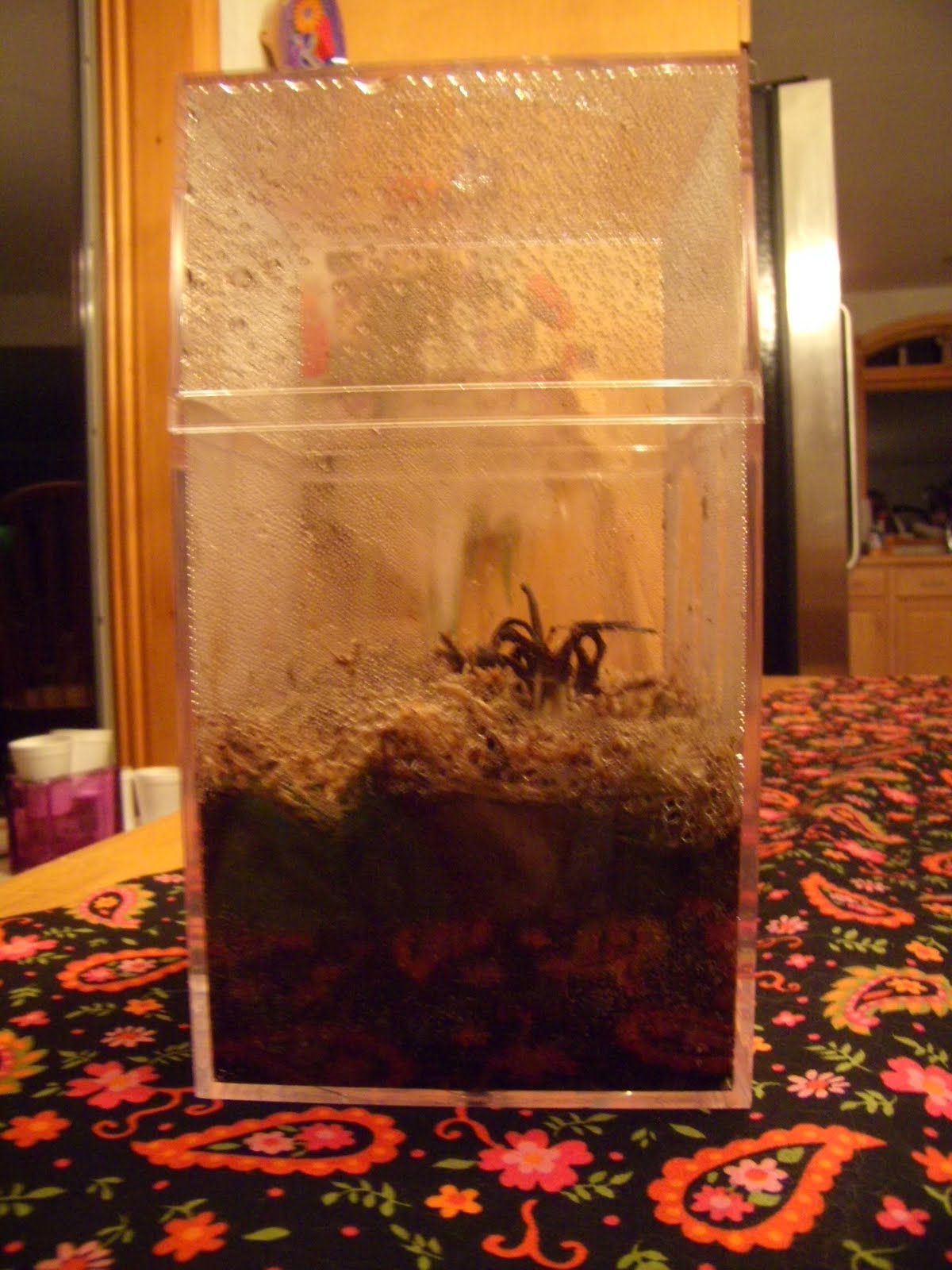
See the two dark clumps in the moss? Aren't they adorable?


After a long day of 90 degree weather and fierce sunshine there is little to indicate if I planted my babies upside-down.